How to Choose a Pickleball Paddle: The 5-Question Decision Framework
There are thousands of pickleball paddles on the market and approximately infinite "top 10 paddles of 2026" blog posts. None of it helps if you don't know which specs matter for you specifically. This framework cuts through the noise: five questions, mapped to concrete spec recommendations, done in 5 minutes.
Question 1: What's Your Skill Level?
Beginner (2.0–3.0)
Spec target: 16mm core, widebody shape, raw 3K Twill carbon fiber, 7.6–7.8 oz. Maximum sweet spot and forgiveness while you build technique.
More detail in our best paddles for beginners guide.
Intermediate (3.0–4.0)
Spec target: 16mm core, widebody or hybrid shape, raw 3K Twill carbon fiber, 7.7–8.0 oz. Still prioritizing forgiveness, but adding spin capability. Our full breakdown lives in best paddles for intermediate players.
Advanced (4.0–4.5+)
Spec target: 14mm or 16mm based on style, hybrid or elongated shape, raw 3K Twill carbon fiber, 7.8–8.2 oz. Now you can specialize — power, control, or hybrid.
Pro (5.0+)
You already know what you need. You're probably reading this to see if we're credible. (We are.)
Question 2: What's Your Play Style?
Banger / Power Player
You drive third shots, favor speed-ups, and win with pace.
Spec target: 14mm core, elongated or hybrid shape, 8.0–8.2 oz, consider adding lead tape at 12 o'clock for extra plow-through.
Control / Touch Player
You dink, drop, and reset. You win rallies by waiting for the error, not forcing it.
Spec target: 16mm core, widebody shape, 7.6–7.9 oz, prioritize twist weight (add tape at 3/9 if needed).
All-Court / Hybrid Player
You mix power and touch depending on the rally.
Spec target: 16mm core, hybrid shape, 7.7–8.0 oz. The all-around default — what we recommend to 60% of players asking.
Question 3: What's Your Body Telling You?
No arm / elbow / shoulder issues
You have full freedom to choose any spec that matches your skill and style.
Occasional elbow twinges or fatigue
Cap weight at 7.8 oz. 16mm core (non-negotiable). Cushioned overgrip. Loose grip technique. Our tennis elbow paddle guide has the full protection protocol.
Active elbow pain or recent injury
7.3–7.6 oz, 16mm core, widebody shape, 4 1/8" grip (sized down from 4 1/4" if needed). And honestly: rest first. No paddle fixes inflamed tendons.
Age 55+
7.3–7.7 oz, 16mm core, widebody, raw carbon face. See our senior paddle guide.
Question 4: What's Your Grip Size?
Three quick sizing methods:
- Ring-finger length method: measure from the bottom crease of your dominant ring finger to the tip. That number in inches is your grip size.
- Index-finger test: hold any paddle with a forehand grip. Slide your non-dominant index finger between your fingertips and palm. Should fit snugly.
- Hand size proxy: most women = 4 1/8", most men = 4 1/4". Larger hands or tennis background = 4 3/8".
Full methodology in our grip size guide. When in doubt, size down and add overgrip.
Question 5: What's Your Budget?
Under $100
Honest answer: buy a $80 fiberglass paddle, commit to playing for 3 months, then upgrade. Entry-level materials are fine for learning.
$100–$150
Careful territory. Quality varies wildly. Look for raw carbon fiber and real honeycomb construction; skip painted composites.
$150–$200
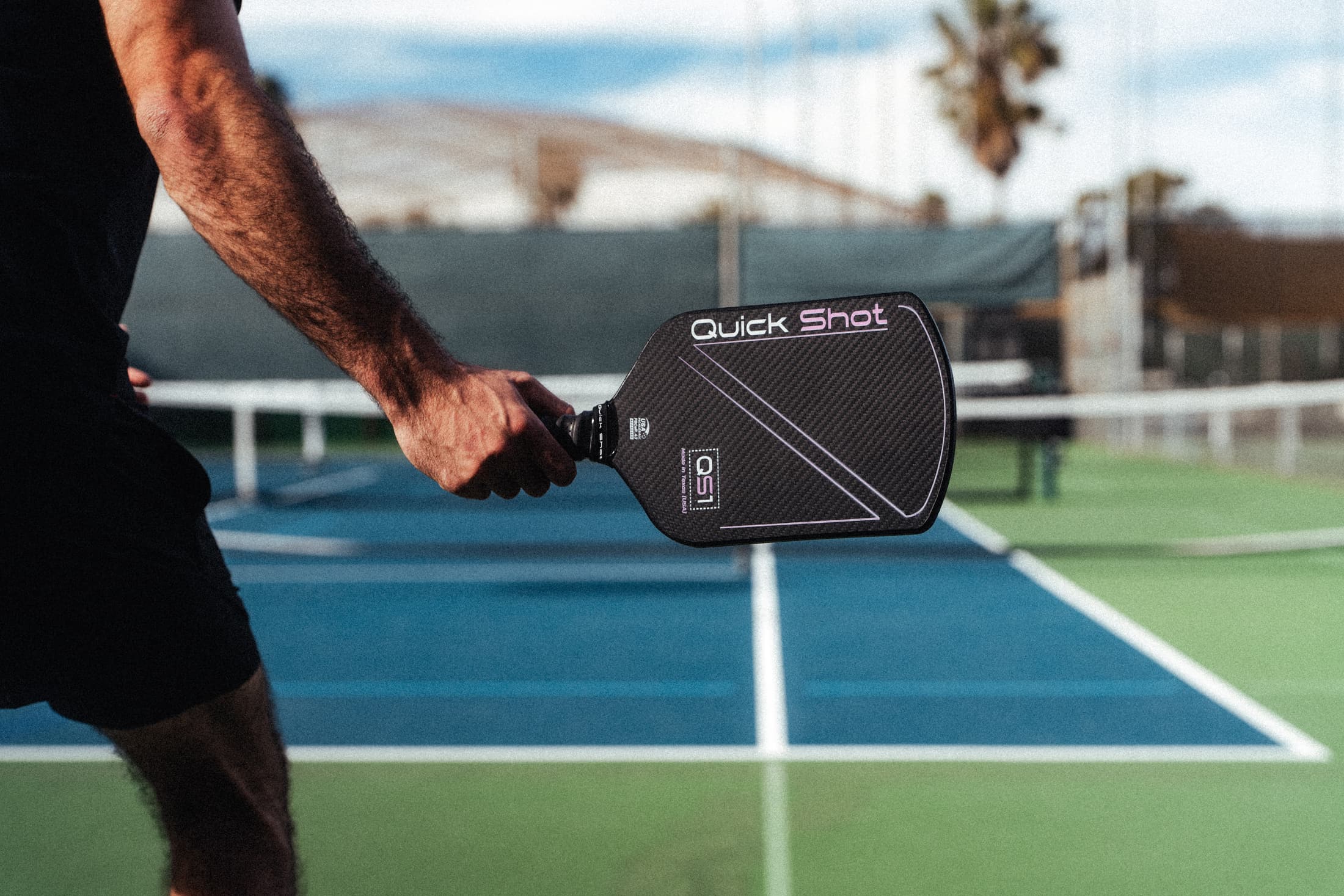
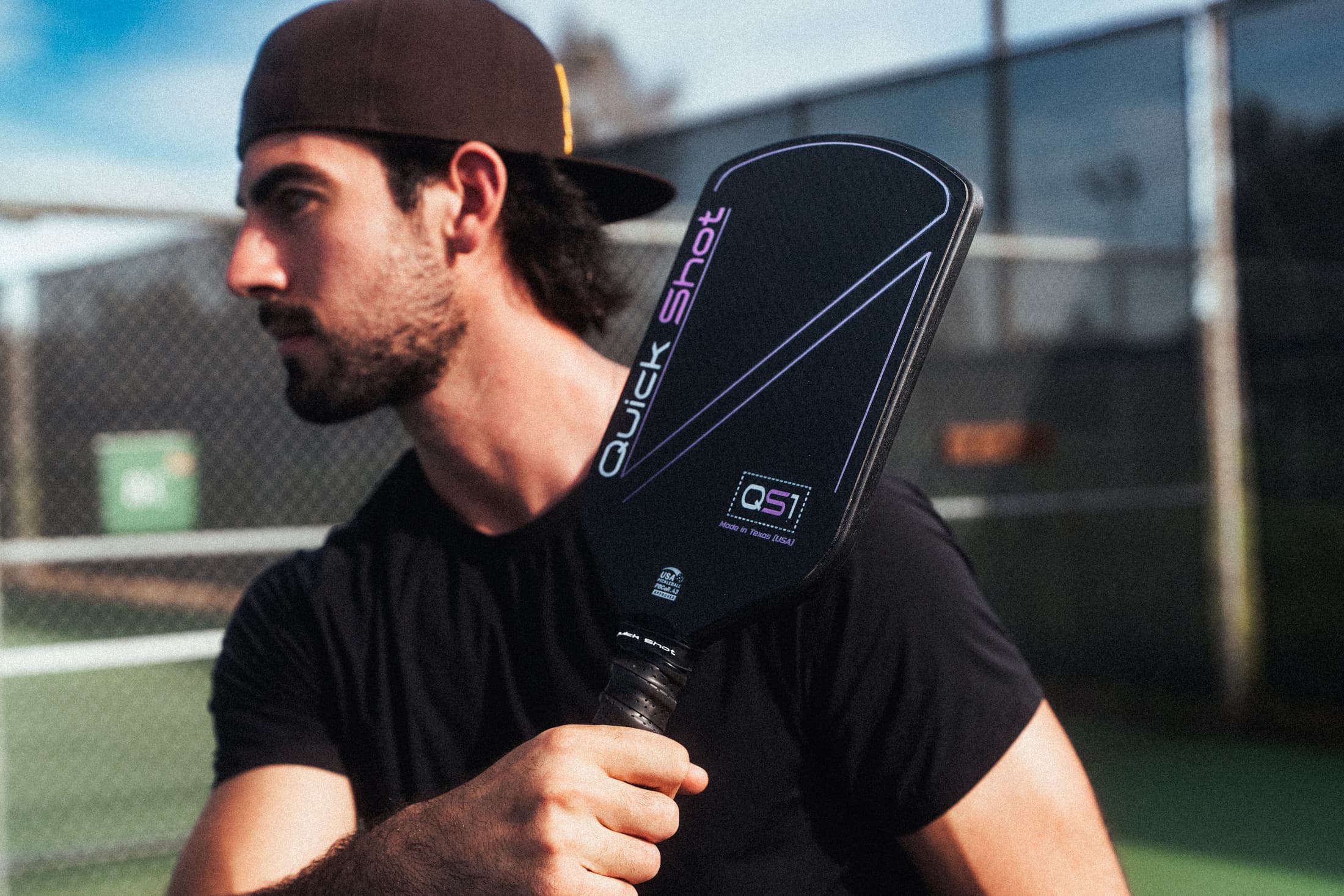
The sweet spot. Premium materials are standard. The Quick Shot QS1 sits here and goes toe-to-toe with anything in the $200–$250 range.
$200–$280
Flagship brand territory. Often buying brand premium as much as material upgrade. Justified if you're 4.5+ and need a specific feature.
$280+
Foam core, exotic face tech, or heavy marketing. Only worth it if you have a clear technical reason.
Ready to Upgrade Your Game?
Shop premium pickleball paddles, designed and manufactured in the US — carbon fiber faces, honeycomb cores, USA Pickleball approved.
Shop Quick Shot PaddlesPutting It Together: Example Paths
Example A: 3.5 female intermediate, occasional elbow fatigue, $180 budget
Quick Shot QS1 at 7.6 oz, 16mm core, 4 1/8" grip, hybrid shape, raw 3K Twill face. Add a cushioned overgrip. ~$150–180.
Example B: 4.5 male aggressive baseline player, no injuries, $250 budget
14mm core, elongated shape, 8.0 oz, 4 1/4" grip. Any top paddle in this spec. Add 3g lead tape at 12 o'clock.
Example C: 60-year-old returning to pickleball after shoulder surgery, $200 budget
Quick Shot QS1 at 7.4 oz, 16mm core, widebody, 4 1/4" grip with cushioned overgrip. Loose grip, shoulder-turn technique.
One Last Tip
If the choice still feels overwhelming, email us your answers to these five questions. Because we build every paddle in our Texas workshop, we can spec one for you directly — grip size, weight, core thickness, shape. Most mass-market brands can't offer that level of customization. For us it's just Tuesday.
Still need more detail on specific specs? Start with our comprehensive best pickleball paddle 2026 guide.
?Frequently Asked Questions

Co-founder and lead play-tester at Quick Shot Paddles. Sets the performance bar for every paddle before it ships.