Pickleball Paddle Grip Size Guide: How to Measure & Choose the Right Fit
Grip size is the quietest variable in paddle selection and one of the loudest offenders in under-performance. The wrong grip costs you spin, control, and (over a season) probably some tendon health. The good news: figuring out the right size takes about 90 seconds.
Why Grip Size Matters
The paddle handle is the only mechanical interface between your body and the ball. Every ounce of spin, every angle change, every reset flows through that one point of contact. If the grip is too large, your wrist cannot snap. If it is too small, the paddle twists in your hand on hard contact and you lose control.
Grip size also has downstream effects on health. A too-large grip forces your forearm muscles to over-engage to stabilize the paddle — the single biggest contributor to pickleball tennis elbow. We wrote a separate guide on the best paddle for tennis elbow and grip size is the first thing we cover there.
Common Grip Sizes in 2026
- 4 1/8" (4.125 in): Small. Best for most women and players with small hands.
- 4 1/4" (4.25 in): Standard. The most common size and the safest default for most adult men.
- 4 3/8" (4.375 in): Large. Uncommon but useful for players with hands longer than 4 inches.
- 4 1/2" (4.5 in): Very rare. Usually only preferred by ex-tennis players transitioning in.
Three Ways to Measure Your Grip Size
Method 1: The Index Finger Test (fastest)
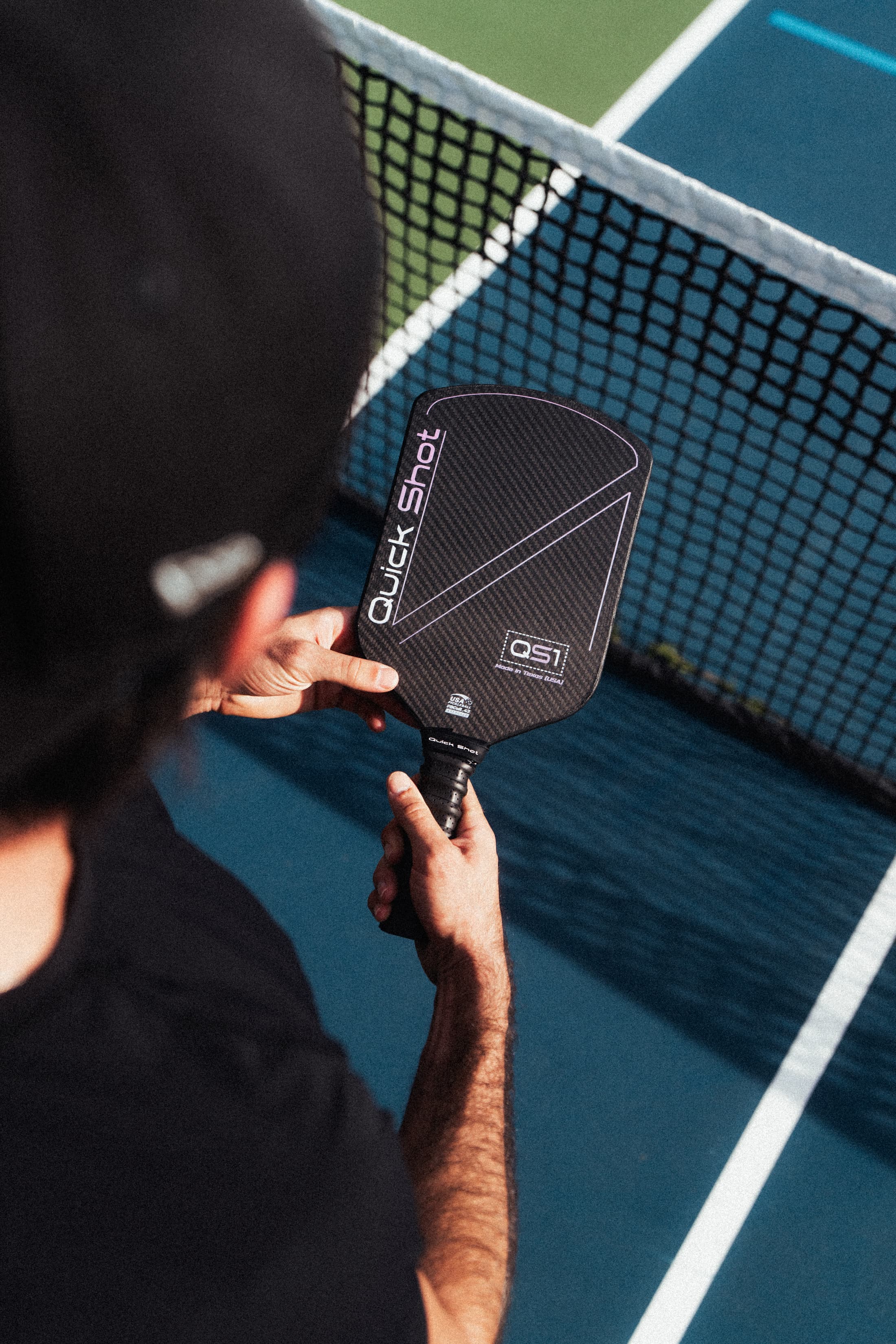
Hold any paddle with an Eastern forehand grip. Slide the index finger of your non-dominant hand into the gap between your ring finger and the base of your thumb. The grip is right when your finger fits snugly — not loose, not squeezed.
Method 2: The Ruler Method
Open your dominant hand flat. Measure from the crease at the bottom of your ring finger to the tip of your ring finger. That measurement, in inches, is your grip size. A 4.25" ring finger = a 4 1/4" grip.
Method 3: The Wrist-Snap Test
Swing the paddle through a slow-motion forehand. If your wrist flicks freely, the grip is right. If your forearm feels locked and the wrist can't rotate, the grip is probably too big. If the paddle feels like it wants to spin in your palm, too small.
Grip Length Matters Too
Handle length is a separate spec from circumference. Longer handles (5.5"+) allow two-handed backhands and higher swing weight. Shorter handles (under 5") give more face area for a wider sweet spot but limit two-hand play. For most players, a 5.25"–5.5" handle is the right balance.
This is especially important if you are coming from tennis and already use a two-handed backhand. Read our guide on elongated vs widebody paddles for how shape interacts with handle length.
Ready to Upgrade Your Game?
Shop premium pickleball paddles, designed and manufactured in the US — carbon fiber faces, honeycomb cores, USA Pickleball approved.
Shop Quick Shot PaddlesFine-Tuning with Overgrips
A single overgrip (Tourna Grip, Gamma Supreme, Wilson Pro) adds about 1/16" to the effective circumference. Two overgrips add about 1/8". This is how pros fine-tune grip feel between tournaments without buying new paddles.
Our rule of thumb: always err on the side of a slightly smaller grip out of the box. Overgrips are cheap, quick to install, and fully reversible. Sanding down a too-large grip is a mess and can compromise the handle structure.
Our Default Grip Spec
Quick Shot paddles ship with a 4 1/4" circumference and a 5.5" handle — the combination that fits the broadest range of adult players and leaves room to customize with an overgrip. Every paddle is built in our Texas workshop, so grip consistency is not a variable from batch to batch. Read more about that process in how we build Quick Shot paddles.
?Frequently Asked Questions

Co-founder and lead play-tester at Quick Shot Paddles. Sets the performance bar for every paddle before it ships.