Best Pickleball Paddles for 3.5 Players: Level Up Your Game in 2026
The jump from 3.0 to 3.5 is one of the most exciting transitions in pickleball. You've got the basics down, you're winning some points, and now you're starting to think about how you win them. That's where paddle choice starts to actually matter.
At 3.5, you're no longer just returning the ball — you're trying to control the game. The paddle that got you here may not be the paddle that takes you further. Here's what to look for.
What Changes at the 3.5 Level
At 3.0, almost any paddle works because consistency is the primary challenge. By 3.5, you've developed enough muscle memory that your paddle's characteristics start to show up in your game — for better or worse:
- Soft game matters more. Dinking rallies last longer. Third-shot drops are in your toolkit. You need a paddle that rewards touch, not just power.
- Spin is becoming a weapon. You're starting to put topspin on drives and slice on resets. Surface texture on your face matters.
- Court positioning is deliberate. You're thinking about the kitchen line. A heavier, slower paddle hurts your reaction time at net.
The Specs That Matter at 3.5
Core Thickness: Start With 16mm
Core thickness is the single most impactful spec for developing 3.5 players. A 16mm polypropylene honeycomb core absorbs vibration and gives you that satisfying "pop" on drives while still feeling soft on dinks. Thinner 14mm cores give more power and pop but punish mishits — save those for when your technique is more locked in. Check out our 14mm vs 16mm core guide for a deeper breakdown.
Weight: 7.6–8.0 oz
This range is the sweet spot for 3.5 players. You get enough mass to drive through the ball on resets and counters without fatiguing your arm across a two-hour session. Lighter than 7.6 oz can make power shots feel inconsistent; heavier than 8.0 oz slows your hands at the kitchen line. See our full paddle weight guide if you want to get granular.
Face Material: Carbon Fiber Over Fiberglass
Fiberglass faces are great for beginners because they flex slightly and create a natural trampoline effect. At 3.5, you want more feedback and spin grip — which is where carbon fiber faces earn their cost. A raw carbon face gives you a textured surface that grabs the ball on topspin drives and slice drops. Read the full carbon fiber vs fiberglass comparison.
Grip Size: Probably Smaller Than You Think
Most recreational players grab a grip that is one size too big. At 3.5, as your wrist action becomes more deliberate, a grip that is slightly undersized (4.0–4.125 inches) lets you generate more snap and spin. You can always layer on an overgrip to dial it in. See our grip size guide to measure your hand properly.
Shape: Standard Width
Elongated paddles give you more reach but shrink the sweet spot and reduce your hand speed at net. At 3.5, where you're still building consistency, a standard-width paddle (roughly 8 inches wide) gives you a more forgiving face and better performance in kitchen exchanges. As your game advances toward 4.0, you can explore elongated shapes if your singles game or baseline play develops.
Control vs. Power: What 3.5 Players Actually Need
Walk into any 3.5 game and watch what loses points. It's rarely "not enough power." It's dinks going into the net, third-shot drops floating too high, and resets sailing out. The game at 3.5 is decided by control, not power.
That said, you don't want a paddle that is so soft it removes all pace from your drives. The ideal 3.5 paddle gives you a soft, responsive feel at the kitchen while still allowing you to generate pace when you step into a ball and drive it.
The 16mm honeycomb foam core design that QuickShot Paddles uses was built with this balance in mind — the core absorbs vibration on defensive shots while the carbon fiber face preserves enough stiffness to generate real drive pace when you want it.
The Quick Shot QS1 for 3.5 Players
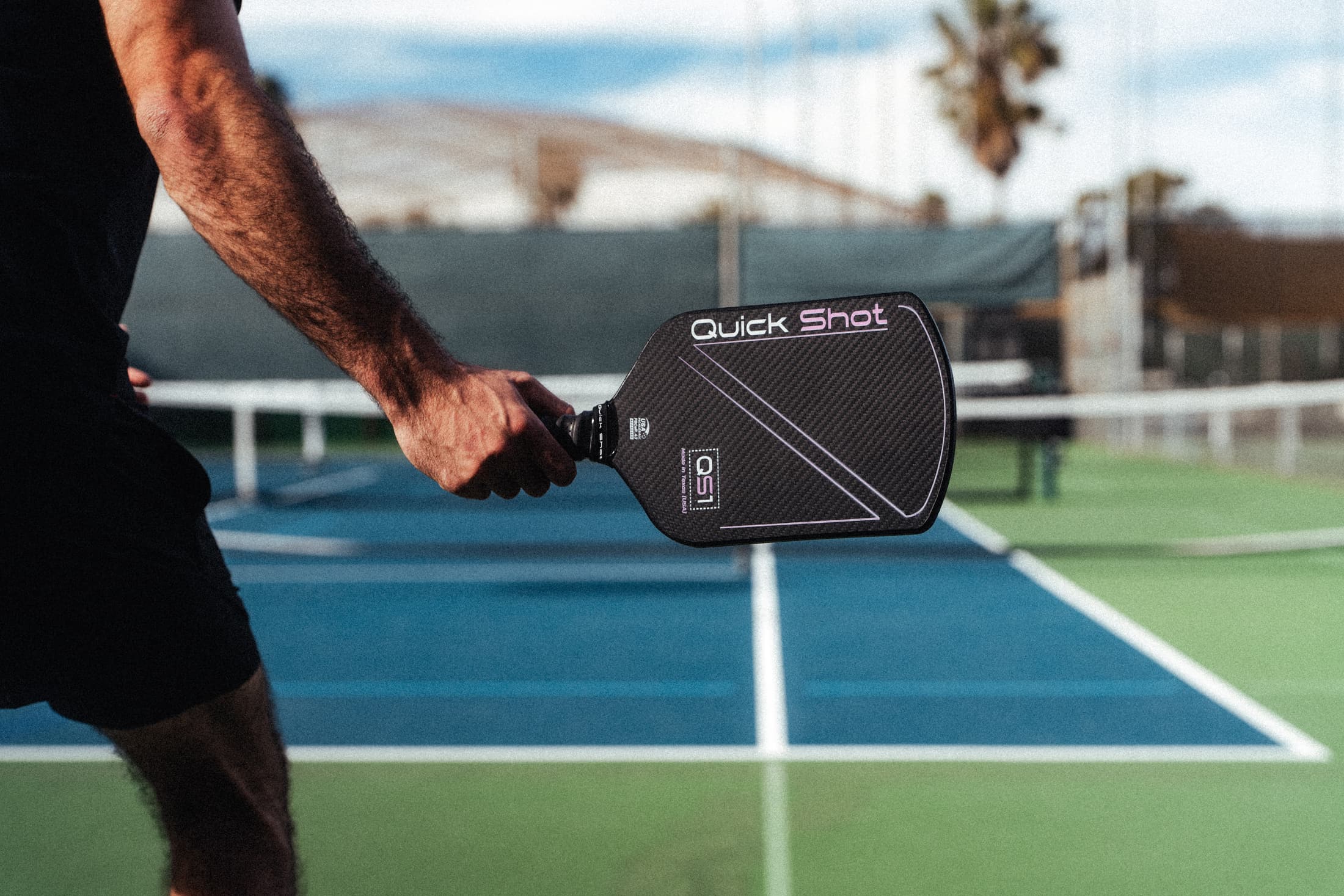
The Quick Shot QS1 is built for exactly this stage of the game. It uses a 14mm honeycomb polymer core and a raw 3K Twill carbon fiber face in a hybrid body — giving you the sweet spot size of a widebody and the reach of an elongated in one paddle. The standout feature is the proprietary vibration-dampening 3D printed grip, which absorbs shock at the handle so your arm stays fresh across long sessions as you put in the court time needed to break through to 4.0.
Find it at quickshotpaddles.com.
Ready to Upgrade Your Game?
Shop premium pickleball paddles, designed and manufactured in the US — carbon fiber faces, honeycomb cores, USA Pickleball approved.
Shop Quick Shot PaddlesCommon Mistakes 3.5 Players Make When Buying a Paddle
- Buying a power paddle to compensate for weak drives. If your drives are weak, the fix is technique and core strength — not a stiffer, lighter paddle. A power paddle at 3.5 makes your soft game worse without fixing the underlying issue.
- Overpaying for tour-level paddles. A $250 tour paddle built for 4.5+ spin mechanics is likely overkill until you have the technique to feel the difference. Get a solid 16mm carbon paddle in the $120–$180 range and invest the rest in drills and court time.
- Using a paddle with a worn-out face. Old paddle faces lose their surface texture — the spin you think you're generating is actually just flat contact. If your paddle is two or three years old, the face may be the reason your drops and dinks are inconsistent.
How Long Will a 3.5-Level Paddle Last?
At 3.5, most players are on the court 2–4 times per week. At that volume, a quality 16mm carbon paddle should stay in competitive condition for 12–18 months before you notice meaningful performance drop. Signs it's time to replace: loss of pop on drives, dead feeling in the core, or visible face delamination. More detail in our paddle lifespan guide.
Bottom Line for 3.5 Players
The paddle that will most accelerate your game from 3.5 toward 4.0 is a 16mm polypropylene or honeycomb foam core in a standard shape, with a raw carbon fiber face, weighing 7.6–8.0 oz, and a grip size that fits your hand comfortably without locking your wrist. Start there, get 100 hours of court time with it, and revisit your preferences as your game evolves.
?Frequently Asked Questions

Co-founder and lead play-tester at Quick Shot Paddles. Sets the performance bar for every paddle before it ships.